When George T. Sargisson and Leroy J. Scheuerman joined founder Thomas C. Marshall Jr. in May 1960 to form Historic Red Clay Valley Inc. (HRCV), the Certificate of Incorporation included the phrase “to issue such publications relating to the Red Clay Creek Valley as the members deem fitting and proper”. Dedicated to recently deceased HRCV founder Thomas C. Marshall Jr., and in recognition of the 150th anniversary of the founding of the Wilmington & Western Rail Road Company in 1869, volunteer Robert Wilhelm has reworked these five monographs.
The limited number of original copies printed has resulted in these monographs becoming difficult to find for recent generations of local historians. Scanned from original mint-condition 5½” by 8½” copies borrowed from long time HRCV member John Iwasyk, the reissues feature 8½” by 11″ letter-size pages and larger printing. As additional information and insight have been uncovered over more than 50 years, the original manuscripts are enhanced with letter-referenced footnotes pointing to additional appendix information.
All five monographs are available free for online reading through the links below. Knowing many folks prefer reading high-quality paper copies, all five monographs have been bound into a single 432-page printed volume with a spiral binding. The printed Monograph Collection is available at the Greenbank Gift Shop or by calling the Business Office and ordering your copy. As the monographs were originally printed as black and white documents, the Monograph Collection is available in grayscale only. If you find the monographs of interest, please consider making a tax-deductible donation to HRCV. Your gift will ensure a long life for this unique piece of Delaware history, and keep the trains on track for many years to come!
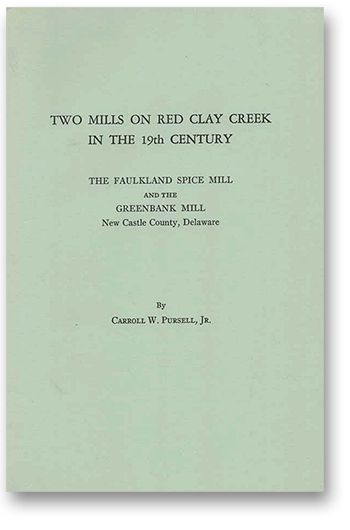
Two Mills On Red Clay Creek In the 19th Century
By Carroll W. Pursell Jr.
First published May 1965
These two mills, constructed on the Red Clay Creek when it ran through the “three lower counties of Pennsylvania” in the 1700s, eventually inspired the names of “Greenbank” and “Faulkland” Delaware. Greenbank Mill’s wooden bentware operation, in addition to its flour milling and woolen milling operations, led to the invention and patenting of the “multi-purpose ladder” which we use today. The mill at Faulkland is where Oliver Evans perfected the first fully automated production process in the world at the end of the 1700s, and later, under ownership of the Fell family, Faulkland became the spice milling capital of the world.
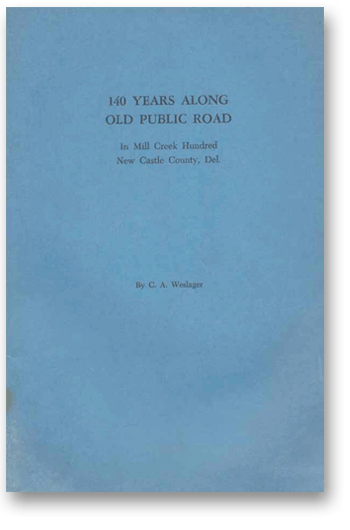
140 Years Along Old Public Road
By C. A. Weslager
First published May 1961
Only remnants of Old Public Road remain today between the former area designated “Hockessin” and “Auburn” (now known as Yorklyn). Noted Delaware historian Weslager follows the evolution of Old Public Road from the days of William Penn’s Manor of Stenning to the present time.
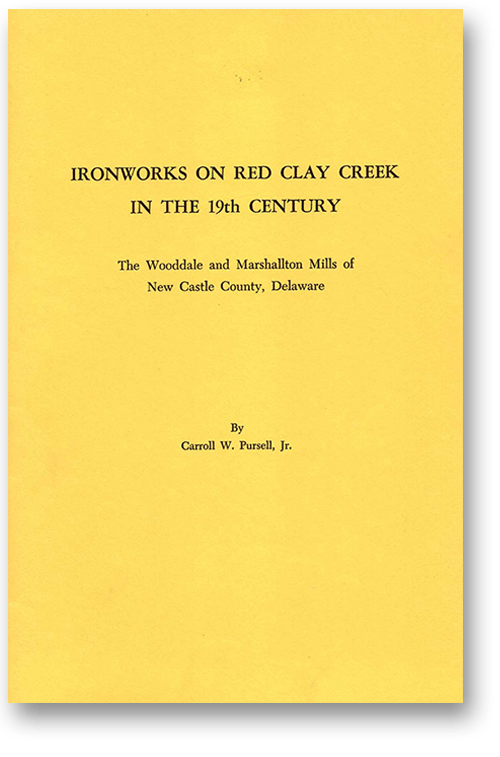
Ironworks On Red Clay Creek In the 19th Century
By Carroll W. Pursell Jr.
First published February 1963
In a September 1871 edition of the Wilmington Every Evening, a walking inspection of the future Wilmington & Western Rail Road route allowed a reporter to pen that Marshall’s Rolling Mills were an “old and well-known sheet-iron mill doing an excellent business”, and Wood’s Rolling Mill as a “well-known and extensive iron works near the Lancaster Pike.” Centuries ago, the first galvanized sheet to be commercially produced in the young country was rolled by the Marshall family. At Wooddale, the nation’s second iron rolling mill was constructed for later producing the nation’s first rust-resistant imitation Russia sheet iron and the shovels used to dig the Delaware & Chesapeake Canal. Pursell’s work details how two of Delaware’s earliest rural rolling mills contributed to the industrial revolution of the 1800s and Delaware’s prominence as an early industrial state in the 1700s and early 1800s.

The Old Hollingsworth Plantation
By C. A. Weslager
First published June 1961
The story of the Hollingsworth Plantation begins with Letitia Penn, one of William Penn’s seven children by his first wife. Known as Letitia Manor, the 15,500 acres given to Letitia by her father was split into multiple parcels in following years. A 225-acre parcel, provided to the Hollingsworth family who performed surveying for William Penn, became the early home for “Ockessin” (Hockessin). With the arrival of the Wilmington & Western Rail Road in 1872 and the construction of a station at the intersection of Mill Creek Road and Lancaster Pike, families moved closer to the station effectively relocating the town of Hockessin.

The Story of the Wilmington and Western Railroad
By Arthur G. Volkman
First published August 1963
Typical of many smaller railroads that sprang up following the Civil War, the Wilmington & Western Railroad hoped to capture the freight and passenger business of the numerous mills and several mining operations located between Wilmington, DE, and Landenberg, PA. Unfortunately, the Long Depression forced the line into receivership a few years after starting operations when it was unable to pay interest on construction bonds. In this monograph, Volkman details how prominent New Castle County, DE, citizens came together to decide a route and construct the 20-mile-long railroad. The first few prosperous years of operation are relived followed by the auction of the line, costing over $700,000 to construct, in a few short minutes for $5,000! This reissue is three-times larger than the original and includes reference materials, photographs, and information uncovered since the original issue.